Canaan, Covenant, and Counter-Culture: Race, Doctrine, and the Restoration
The story of human prejudice in Scripture often begins close to home. In the Hebrew Bible, Jonah initially refuses God’s command to preach to the people of Nineveh because of their nationality, famously declaring he would rather die than see “those sinners” spared (Jonah 1–4). In the New Testament, Peter struggles with similar assumptions about outsiders. In the account of Cornelius (Acts 10), Peter must wrestle with his own ingrained notions about Jews versus Gentiles before receiving divine instruction to baptize without distinction. These narratives demonstrate that even God’s prophets and apostles sometimes struggled with bias, illustrating that discrimination is not only cultural but human, and that God’s guidance often challenges these assumptions.
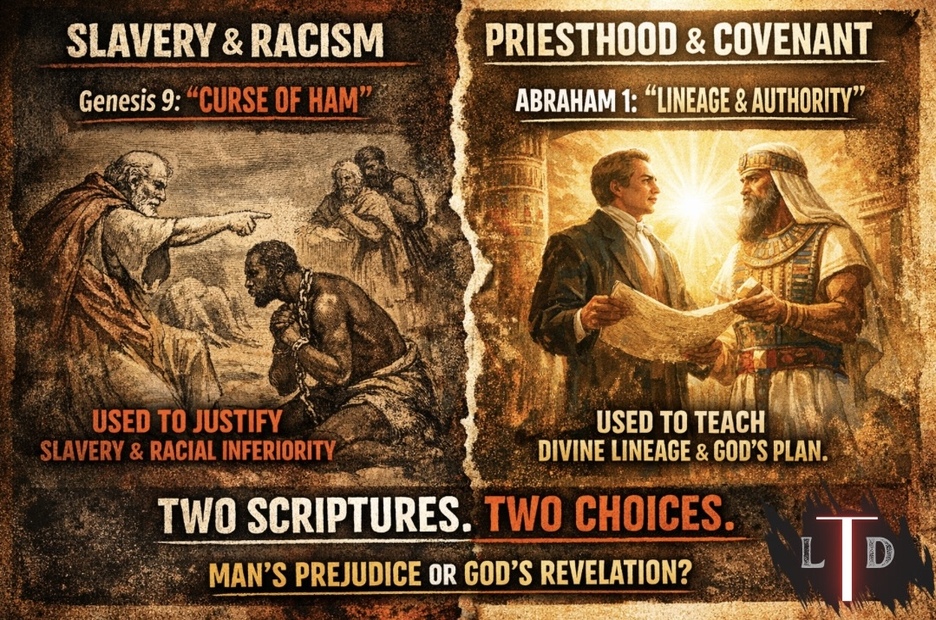
Within the Restoration, Joseph Smith inherited a society steeped in racial hierarchy. Mainstream American Protestantism frequently interpreted Genesis 9, the story of Noah’s curse on Canaan, to justify slavery and assert white supremacy. The curse of Ham — a label applied centuries later — was often presented as divinely sanctioned racial subordination. Prominent theologians, newspapers, and sermons used this passage to rationalize African enslavement and social exclusion, embedding a theological rationale into public morality.
Early Latter-day Saint leaders were not entirely immune to prevailing cultural views. A few made insensitive comments about people of African descent, reflecting broader American assumptions.
However, these statements must be distinguished from official doctrine. Doctrine is revealed teaching accepted by the Church as binding; personal opinions or speculation, even by leaders, are not doctrine. The Church today disavows such statements and emphasizes that they were opinions of men, not inspired declarations of God.
Abraham 1: A Restoration Perspective on Lineage
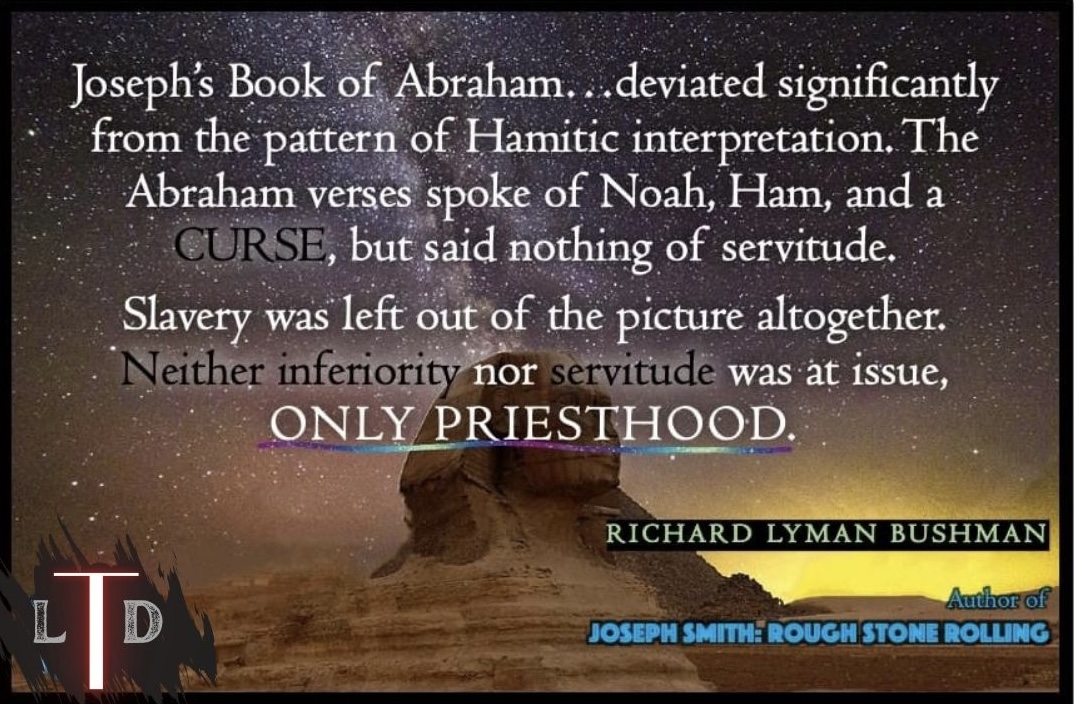
Amid this environment, the Book of Abraham (Abraham 1) emerged, offering a theological reorientation. Unlike mainstream Protestant interpretations that read Genesis 9 through the lens of racial hierarchy, Abraham 1 frames divine authority and priesthood in terms of lineage, covenant, and divine appointment, not skin color. Pharaoh’s lineage is described in relation to priesthood authority; Ham’s descendants are included in historical and covenantal narratives without any intrinsic racial inferiority.
The text reframes a culture-saturated biblical story, shifting the focus from ethnic or racial subjugation to covenantal responsibility. In doing so, the Restoration maintains continuity with biblical precedent — God has often limited sacred authority to specific lineages, as with Aaron and the Levites — while challenging the misuse of Scripture to justify oppression.
Doctrine vs. Opinion in LDS History
In early LDS history, this distinction becomes crucial. Doctrinally, priesthood eligibility has always been linked to lineage, worthiness, and divine authority, not skin color. Any statements by leaders suggesting otherwise, or linking restrictions to race, fall under historical opinion, not revealed doctrine.
- Doctrine: Priesthood and covenant authority are determined by God and lineage where specified (e.g., Abrahamic covenant or Levitical precedent).
- Opinion: Any racial justification for restrictions, or assumptions about the “fitness” of a race for priesthood, were cultural interpolations, influenced by 19th- and early 20th-century America.
From Joseph Smith’s lifetime through 1978, some members and leaders allowed cultural assumptions to influence their interpretations. Yet the Church teaches today that such influences do not define God’s will, and it disavows racial explanations for the prior restriction.
The 1978 Revelation and Modern Understanding
In 1978, the LDS Church received official revelation lifting the priesthood restriction for men of African descent (Doctrine and Covenants Official Declaration 2). This event underscores a central tenet of Restoration theology: revelation is ongoing, and doctrine is clarified through God’s guidance, not societal convention.
The modern position is clear:
- Doctrine today: No one is restricted from priesthood or temple participation based on race or skin color. Worthiness, not phenotype, governs access to priesthood authority.
- Disavowed statements: Early comments by leaders attributing priesthood restrictions to race are explicitly rejected as incorrect and culturally conditioned.
- Rooted in lineage: The original doctrinal framework was lineage-based (following biblical precedent), not racial, even if some explanations were distorted by cultural prejudice.
This understanding allows members to acknowledge historical mistakes without conflating them with the core theology of the Restoration.
Putting It Together: Countercultural Intervention
Viewed in context, the Restoration’s teachings on lineage and covenant were remarkably counter-cultural for antebellum America. While mainstream churches often justified slavery and racial hierarchy with scripture, Joseph Smith’s theology emphasized universal divine heritage and covenantal potential. Even within the constraints of his era, early Latter-day Saint teachings introduced principles that challenged widespread assumptions about race and human value.
Abraham 1, in particular, demonstrates how the Restoration could reframe biblical texts to challenge misinterpretations used to oppress. Where other denominations weaponized Genesis 9 to justify social subjugation, Restoration scripture placed authority in divine appointment, not pigment, setting a theological foundation that anticipated more inclusive practice in later revelation.
Conclusion
The history of LDS teaching on race and priesthood is complex. Biblical figures like Jonah and Peter illustrate that human bias is longstanding, while mainstream Protestantism in 19th-century America entrenched racial prejudice under the guise of divine law. Abraham 1 shows that the Restoration intervened in this debate, emphasizing lineage and covenant over skin color.
By distinguishing opinion from doctrine, the Church clarifies that historical statements about race were never doctrinal imperatives. Today, the LDS Church teaches that all worthy men may hold the priesthood, and all worthy individuals may participate fully in temple ordinances, regardless of race. Doctrine was rooted in lineage, not color, even if the majority culture sometimes bled into explanations before 1978.
In this light, the Restoration serves as both a continuation of biblical patterns and a corrective to human prejudice — a counter-cultural theological intervention in an era when Scripture was often misused to justify inequality. It highlights that revelation, lineage, and covenantal authority, rather than skin color, remain central to the faith.