
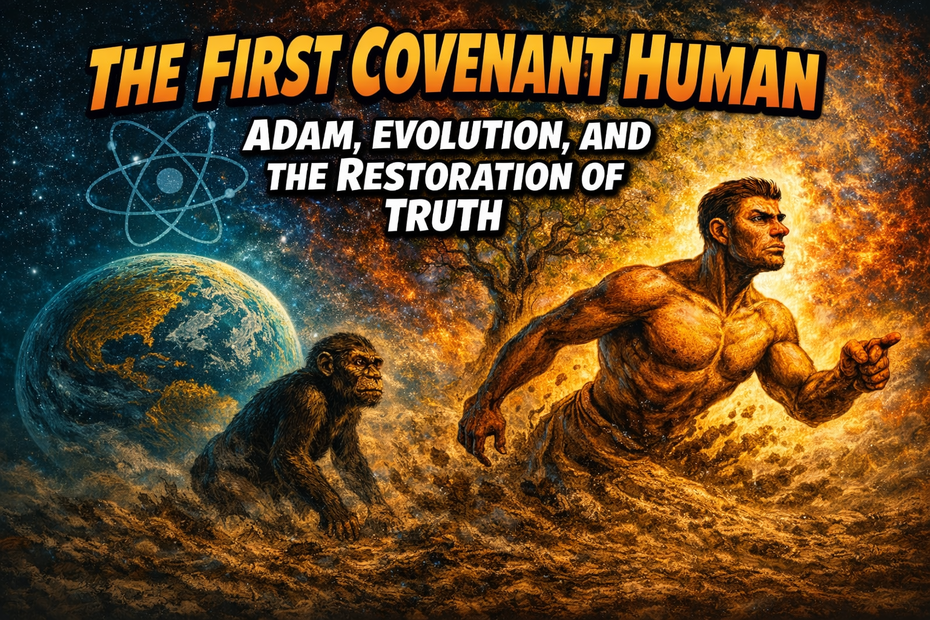
The First Covenant Human: Adam, Evolution, and the Restoration of Truth
For more than a century, many people have believed they must choose between two stories about human origins.
One story comes from science. It says that life on earth developed slowly across immense stretches of time. Creatures emerged, adapted, and diversified over millions of years until eventually human beings appeared.
The other story comes from scripture. It says that God formed Adam from the dust of the earth and placed him in the Garden of Eden.
To many readers, these two accounts seem to contradict each other.
One appears ancient and theological. The other appears modern and scientific.
Yet the scriptures themselves contain hints that the conflict between these two views may never have been necessary.
What if the biblical story of Adam was never meant to describe the biological origin of the human species, but something far more sacred?
What if it describes the moment when God first entered into covenant with humanity?
A small but important detail in the text suggests this possibility.
Adam Was Placed in the Garden
In the book of Book of Genesis we read something curious:
“And the Lord God took the man, and put him into the garden of Eden to dress it and to keep it.”
— Genesis 2:15
Notice the wording carefully.
God took the man and placed him in the Garden.
The passage does not explicitly say Adam was created inside Eden. Instead, it suggests he was brought there.
That subtle detail raises an intriguing possibility.
Perhaps Adam was not the first biological human who ever lived on earth.
Perhaps he was the first human called to walk with God.
Formed from the Dust of the Earth
The scriptures repeatedly describe humanity as being formed from the dust of the earth.
“The Lord God formed man of the dust of the ground, and breathed into his nostrils the breath of life.”
— Genesis 2:7
To ancient readers, this phrase emphasized humility: humanity came from the soil and would eventually return to it.
Yet modern science has revealed something remarkable.
Every atom in the human body comes from the earth itself.
Carbon, oxygen, calcium, iron, nitrogen—the fundamental elements that compose our bodies were drawn from the soil, water, and air of this planet.
In the most literal sense possible, human beings truly are made from the dust of the earth.
Scripture even hints that the earth itself participated in the development of life.
“Let the earth bring forth the living creature.”
— Genesis 1:24
Notice the pattern.
God commands.
But the earth brings forth life.
The earth becomes an instrument through which creation unfolds.
Creation in Vast Periods of Time
Another common assumption about the Genesis account is that creation occurred in six literal 24-hour days.
Yet the scriptures themselves leave room for a much broader understanding of time.
The apostle Simon Peter wrote:
“One day is with the Lord as a thousand years, and a thousand years as one day.”
— 2 Peter 3:8
Divine time, in other words, does not necessarily operate according to human clocks.
Restoration scripture echoes this idea. In the book of Book of Abraham, the creation narrative repeatedly describes stages of creation not as days but as “the first time,” “the second time,” and so forth (Abraham 4).
This language suggests phases or periods rather than strict calendar days.
Seen this way, the immense ages described by geology and biology may simply reflect the long unfolding of God’s creative work.
The Earth as God’s Instrument
From this perspective, natural processes do not remove God from creation.
They may reveal how He creates.
Just as a gardener patiently cultivates the soil before planting a tree, God may have allowed life to develop through the laws embedded within the universe.
Across immense ages the earth changed.
Life appeared in the oceans.
Plants covered the land.
Animals filled the skies and forests.
Eventually, creatures capable of reason, culture, and language appeared.
Human beings.
Yet even if biological humans existed before Adam, the scriptures focus on something deeper than biology.
They focus on covenant.
Adam and the Beginning of Covenant
Adam may represent the moment when God first revealed Himself to humanity in a direct and personal way.
In this sense, Adam becomes not merely the first man to exist, but the first prophet of the human family.
The one who first heard the voice of God.
The one who walked in sacred space with his Creator.
The book of Book of Moses portrays Adam receiving commandments, offering sacrifice, and learning the plan of redemption.
In that sense, Adam’s role resembles that of later prophets who would also stand between heaven and earth.
Through Adam, humanity’s spiritual history begins.
The Garden as Sacred Ground
If Adam existed before entering Eden, then the Garden itself may have been something unique.
Rather than the birthplace of humanity, it may have been a sanctuary on earth.
A place where heaven and earth briefly overlapped.
Scripture describes the Garden as containing the Tree of Life, whose fruit had extraordinary power.
After Adam and Eve transgressed, God declared:
“Lest he put forth his hand, and take also of the tree of life, and eat, and live for ever.”
— Genesis 3:22
This statement suggests that immortality was conditional.
While Adam remained in the Garden and had access to the Tree of Life, he could have continued living indefinitely.
But once expelled from Eden, that sustaining influence was removed.
Outside the Garden, the natural world continued as it always had—with birth, growth, and death.
Inside the Garden, however, Adam and Eve lived under a sacred condition sustained by God’s presence.
Voices from the Restoration
Interestingly, several early leaders of The Church of Jesus Christ of Latter-day Saints were open to the idea that creation unfolded gradually under divine direction.
Brigham Young taught that the earth was organized from existing matter and that God may have worked through processes not yet understood.
James E. Talmage suggested that the “days” of creation could represent vast periods of time and that scientific discoveries about the age of the earth need not conflict with faith.
B. H. Roberts likewise explored the possibility that humanity’s physical development may have been part of the earth’s long preparation under divine guidance.
None of these views remove God from creation.
Instead, they suggest that divine creation may operate through law, process, and time.
The Second Adam
The story of Adam ultimately points forward to someone greater.
In the New Testament, the apostle Paul the Apostle draws a powerful comparison between Adam and Jesus Christ.
Writing in First Epistle to the Corinthians, he declares:
“The first man Adam was made a living soul; the last Adam was made a quickening spirit.”
— 1 Corinthians 15:45
Adam represents the beginning of mortal humanity.
Christ represents the beginning of redeemed humanity.
Paul summarizes the relationship simply:
“For as in Adam all die, even so in Christ shall all be made alive.”
— 1 Corinthians 15:22
Through Adam came mortality.
Through Christ comes resurrection.
Through Adam began the human story.
Through Christ comes its redemption.
The Dust and the Divine
In the end, the scriptures reveal two truths that stand side by side.
Human beings are made of dust.
Yet we are also children of God.
The dust speaks of our physical origin.
The divine calling speaks of our eternal destiny.
Adam stands at the meeting point of those two realities—a being formed from the earth, yet chosen to walk with God.
And in that sacred moment, when the dust first heard the voice of heaven, the true story of humanity began.