
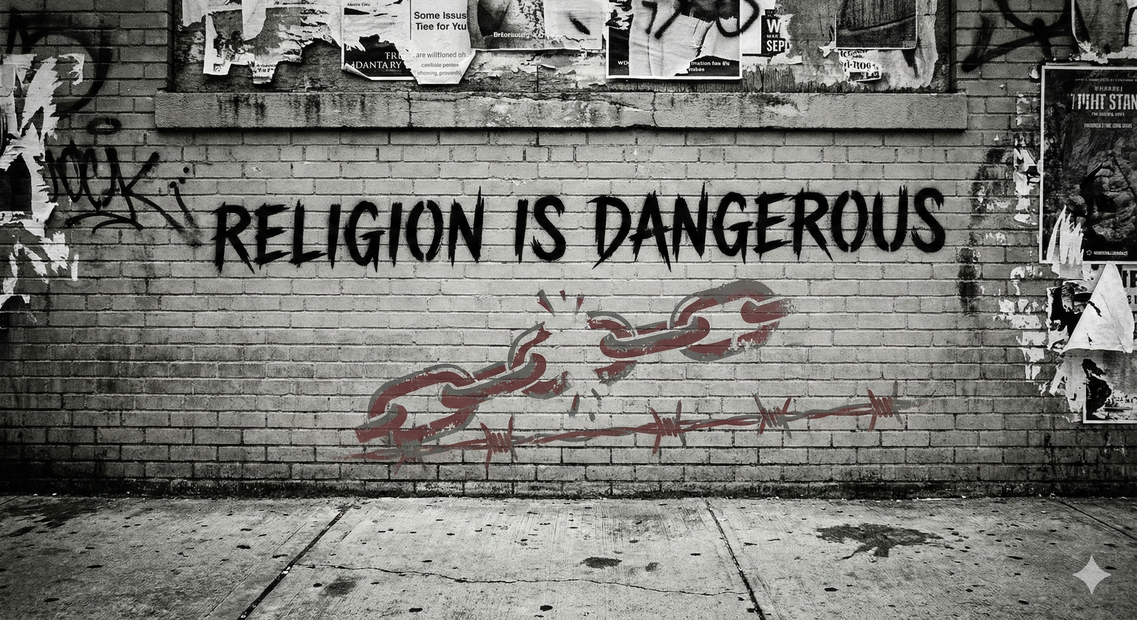
The “Religion-Causes-War Lie”- Why We’ve Been Fed a Story That Isn’t True
For decades, a simple, seductive idea has circulated in media, academia, and popular culture: religion is the cause of war. It’s repeated in books, documentaries, talk shows, and interviews. Celebrities, comedians, and intellectuals have turned it into an unquestioned mantra: if there’s bloodshed, if there’s terrorism, if there’s sectarian strife, religion must be the culprit.
It’s a lie. A deliberate oversimplification that has captivated millions. And it’s time someone said so bluntly.
The Numbers Tell a Different Story
Let’s start with facts, the ones often buried behind soundbites. The Encyclopedia of Wars records 1,763 conflicts spanning human history. How many were primarily caused by religion? Only 121 wars — roughly 7%.¹
Even among those, a closer look shows religion rarely acted alone. The Crusades? Sure, faith was invoked, but controlling trade routes and expanding territorial power mattered just as much. The Thirty Years’ War? Catholics vs. Protestants in name, but the underlying struggle was about dynastic power, political sovereignty, and economics.²
Steven Pinker’s The Better Angels of Our Nature reminds us that of the 21 worst atrocities in history, only three have a clear religious component.³ The rest? Secular ambition, ideology, greed, ethnicity, and imperialism.
Put bluntly: if you think religion is the engine of human violence, you’re ignoring 93% of historical wars and atrocities.
Why the Lie Persists
Why does this false narrative endure? Because it’s convenient, morally satisfying, and theatrically potent.
- Simplicity: “Religion = war” is an easy headline. It satisfies a human craving for clear villains.
- Celebrity amplification: Figures like Richard Dawkins, Sam Harris, and Christopher Hitchens package this idea in books, documentaries, and interviews. They wield moral authority, intellectual polish, and massive audiences. When they say religion is violent, millions nod along without examining the data.⁴
- Media dramatization: Entertainers like Bill Maher, Ricky Gervais, Seth MacFarlane, and Patton Oswalt extend the message to pop culture. Through comedy, satire, and talk shows, they frame religion not as a source of meaning or morality but as a dangerous institution prone to violence.⁵
The effect? The public absorbs a narrative that is intellectually lazy and historically inaccurate. Religion becomes a global villain, a scapegoat for the world’s ills.
The Consequences of Believing the Lie
Accepting this falsehood is not harmless. It:
- Encourages cultural cynicism, where entire civilizations and billions of believers are dismissed as dangerous or irrational.
- Promotes moral arrogance, the assumption that secular, modernist worldviews are inherently superior.
- Fosters historical ignorance, erasing the actual drivers of war: land, resources, power, and ideology.
In other words, it warps public understanding, fuels ideological hostility, and blinds us to the real mechanics of human conflict.
Religion Is Not Innocent, But It’s Not the Main Culprit
Let’s be honest. Religion has been misused. Leaders have twisted faith to justify conquest, persecution, and terror. That misuse is undeniable. But corruption is not essence. To blame religion itself is like blaming a knife for a murder. A tool can be misapplied; the fault lies with those who wield it.
Look at history objectively:
- World Wars I and II — nationalism, imperialism, totalitarian ideology. Religion barely registers.
- Vietnam War — Cold War geopolitics and anti-communism, not theology.
- Napoleonic Wars — territorial conquest and political domination, with religion serving as a tool rather than a driver.
Yes, religion can inspire, justify, and amplify conflict. But it is rarely the spark. Political ambition, economic incentives, ethnic tensions, and ideological zeal are far more decisive.
A Wake-Up Call
It’s time to stop repeating this lie. To those who believe it: examine the evidence. Question the authority of the celebrities, authors, and pundits who package this myth as truth. Insist on nuance. Acknowledge the messy, complicated realities of human history.
We must resist the reductionist narrative. Religion does not cause war. Human ambition, greed, ideology, and fear cause war. Religion is often dragged into the fight — sometimes distorted, sometimes weaponized — but it is not the origin. To see it otherwise is to surrender to the convenient lie.
If you care about truth, stop accepting headlines as history. Stop letting the voices of Maher, Gervais, Dawkins, or Harris define your worldview. Look at the data, think critically, and reclaim your understanding of history. The claim that religion causes war is not merely exaggerated — it’s false. And the cost of believing it is real.
Footnotes
- Encyclopedia of Wars, Charles Phillips & Alan Axelrod, 2010, p. 12.
- Benjamin Wiker, “The Myth of Religion as the Cause of Most Wars,” APholt.com, 2023.
- Steven Pinker, The Better Angels of Our Nature, Penguin, 2011.
- Richard Dawkins, The God Delusion, Bantam, 2006; Sam Harris, The End of Faith, W.W. Norton, 2004; Christopher Hitchens, God Is Not Great, Twelve, 2007.
- Bill Maher, Religulous, Warner Independent Pictures, 2008; Ricky Gervais, interviews and stand-up specials, 2005–2020; Seth MacFarlane, interviews, 2010–2020; Patton Oswalt, comedy specials, 2012–2018.
Selected Bibliography
- Charles Phillips & Alan Axelrod, Encyclopedia of Wars.
- Benjamin Wiker / Andrew Holt (eds.), “The Myth of Religion as the Cause of Most Wars,” APholt.com, 2023.
- Steven Pinker, The Better Angels of Our Nature, Penguin, 2011.
- Richard Dawkins, The God Delusion, Bantam, 2006.
- Sam Harris, The End of Faith, W.W. Norton, 2004.
- Christopher Hitchens, God Is Not Great, Twelve, 2007.
Bill Maher, Religulous, Warner Independent Pictures, 2008.