
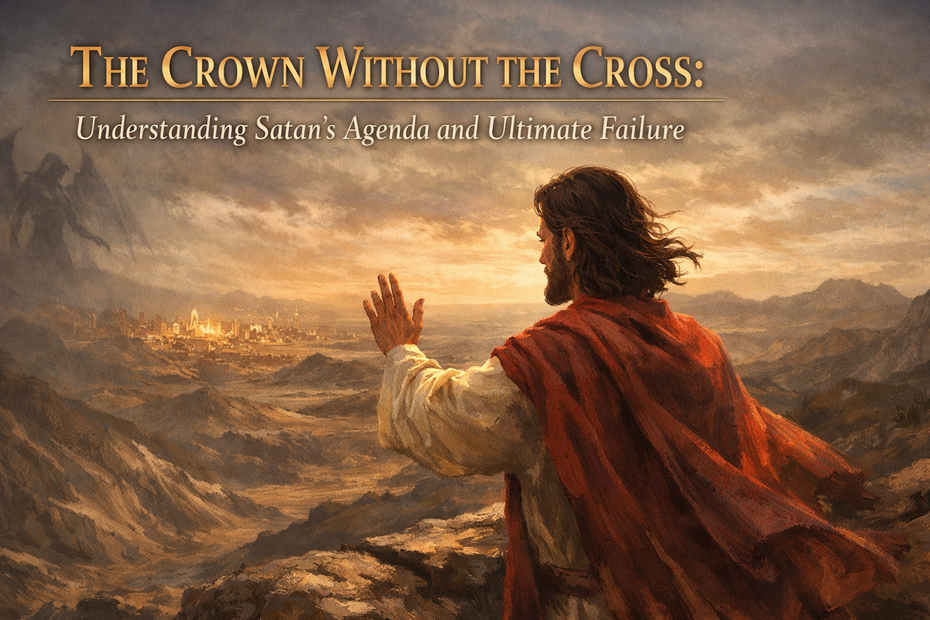
The Crown Without the Cross: Understanding Satan’s Agenda and Ultimate Failure
One of the most intriguing questions in Christian theology is this: When Satan offered Jesus “all the kingdoms of the world” during the temptation in the wilderness, why would he think he could offer the Creator His own world? At first glance, it seems absurd. Jesus, as the Creator, knows every star and stone of the universe. Surely He would see through any deception. And yet, the account in Matthew 4 and Luke 4 is not about tricking God—it is about revealing the personality, motivations, and persistent tactics of Satan.
From scripture, we know that Jesus was never in danger of being deceived. He fully understood the Father’s plan, the ultimate destiny of His Atonement, and the eternal order of all things. Satan’s temptation, then, was about offering a shortcut to power, a “crown without the cross.” By claiming authority over the kingdoms of the world, Satan was appealing to ambition and glory: the same lure that ensnared Adam and Eve, the same lure he will use over and over in human history.
Satan’s offer rests on two key concepts: partial insight and persuasion. Scripture describes him as “the god of this world” (2 Corinthians 4:4) and “the prince of this world” (John 12:31). These titles do not mean he truly owns the world—he cannot create, and he cannot control God—but they indicate the sphere of influence he temporarily exerts over sin, human weakness, and worldly systems. In other words, he operates through manipulation, deception, and exploitation of the fallen condition, hoping to sway allegiance by offering authority and glory that belong only to God.
His thinking is both strategic and tragically flawed. He believes that if Jesus acknowledges his authority—even symbolically—he can shortcut the covenantal process and claim power that should come only through obedience, sacrifice, and the Atonement. It is the ultimate act of pride: attempting to bend reality to his self-exalted vision. But he is working with incomplete understanding. He knows enough to tempt, to appeal to human desire for recognition and control, but he does not comprehend God’s eternal purposes, the necessity of agency, or the certainty of Christ’s victory.
This encounter reveals Satan’s personality more broadly. He is cunning, persuasive, and relentless, always seeking to exalt himself while undermining God’s plan. He uses whatever influence he still retains—wealth, political power, fear, and human ambition—but every attempt is ultimately doomed. His agenda is consistent across scripture: he seeks control, demands worship, and tries to circumvent the proper path to glory. Yet, his knowledge is limited, his perspective myopic, and his methods ultimately impotent against the divine will.
The lesson of the temptation extends beyond the cosmic drama. It models the strategies Satan uses throughout human history. He offers the “shortcut” to power, recognition, or wealth, appealing to pride and impatience. He exploits existing systems—economic, political, and social—to persuade humans to compromise eternal principles. But just as in the wilderness, these shortcuts are illusions. True authority, true glory, and true reward come only through obedience, sacrifice, and alignment with God’s plan.
In the end, the story of the wilderness temptation is not about whether Jesus could be tricked. It is about revealing Satan’s character: proud, ambitious, cunning, and always attempting to offer the crown without the cross. And it is about revealing God’s order: even the most persuasive and clever of adversaries cannot succeed when obedience, agency, and sacrifice govern the universe. For humanity, it is both a warning and a guide: temptation will always promise ease and immediate gratification, but real growth and real power come only through the way God has established.
Satan’s ultimate failure is also a comfort. His agenda may be relentless, but it is limited, flawed, and destined to fail. The Creator cannot be deceived, His purposes cannot be undermined, and those who align with Him can see through the illusions. The crown without the cross will never succeed—because the cross is exactly what gives the crown its meaning.